 how-to
How to Transport Funeral Flower Arrangements Safely
Table of Contents
- What You'll Need Before You Move Any Flowers
- Step-by-Step: How to Transport Funeral Flower Arrangements
- Funeral Flower Etiquette: What to Know Before You Deliver
- How to Keep Sympathy Flowers Fresh During and After Transit
- What to Include in a Sympathy Card When You Deliver
- DIY Transport vs. Professional Florist Delivery
- Common Mistakes That Damage Funeral Flowers in Transit
- Frequently Asked Questions
Last Updated: September 26, 2026
What You'll Need Before You Move Any Flowers
Moving a sympathy arrangement without damage starts with the right supplies, gathered before you touch the flowers. A little prep work now prevents cracked containers and bruised blooms later.
Here's what to have ready:
- A flat, stable surface for staging the arrangement
- Plastic wrap or a large trash bag to cover the base
- Twine or soft string for tying stems and securing the piece
- Old towels or blankets for cushioning and blocking movement
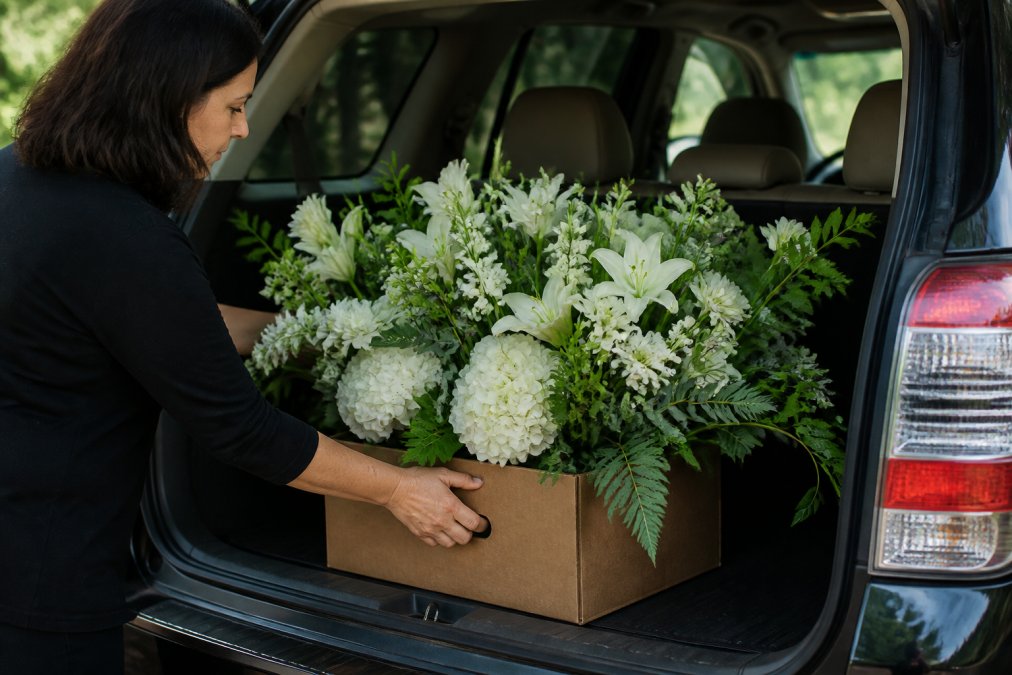
- A cardboard box or laundry basket for smaller arrangements
- A spray bottle of water to top off hydration
- Non-slip shelf liner or a rubber mat for the vehicle floor
If you ordered directly from a local florist, ask whether the arrangement can be delivered instead. That single question saves most people the whole job.
Step-by-Step: How to Transport Funeral Flower Arrangements
The safe method for how to transport funeral flower arrangements comes down to three phases: prep the piece, pack it so it cannot shift, then load and drive with care. Each phase takes minutes, but skipping any one of them is how arrangements arrive broken.
Step 1: Prep the Arrangement and Check Hydration
Start by checking the water level. Floral foam should be soaked through, and vases should be filled to a normal level. Add water now, not at the funeral home.
Next, decide what stays and what goes:
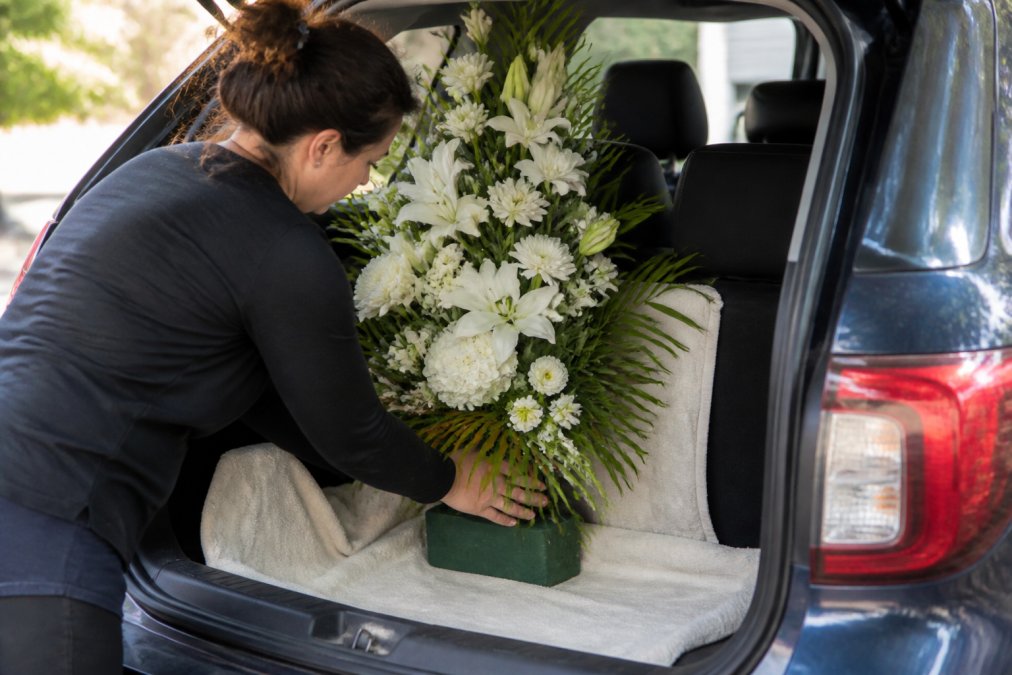
- Casket sprays and standing sprays: leave them on their easel or stand. These are set pieces and are not meant to be lifted off.
- Vase arrangements: keep the flowers in the vase. Moving loose cut flowers causes more damage than moving the whole piece.
- Baskets and plants: leave them as they are, but check that the liner is not leaking.
Wrap the base in plastic to catch drips. Then tie the stems or the arrangement's frame loosely to its container so nothing slides.
Step 2: Pack and Stabilize for the Ride
Stabilizing the arrangement is the step most people rush, and it's the one that matters most. An arrangement that can slide even a few inches will tip on the first hard turn.
Line the floor or cargo area with towels. Set the arrangement down and pack towels or blankets around the base until it cannot move in any direction.
Step 3: Load, Drive, and Unload at the Service
Load the arrangement last so it is the first thing out. Keep the vehicle cool, and avoid direct sun on the flowers.
Funeral Flower Etiquette: What to Know Before You Deliver
- Timing is a delivery window, not a moment. Funeral homes typically receive deliveries during posted business hours, often with a cutoff the morning of the service. Call ahead and ask for the specific window, "before the 10 a.m. service" is not the same as "by 9 a.m. so we can place it before the family arrives."
- The delivery address is usually the funeral home, not the graveside. Even for a graveside service, most funeral homes coordinate moving arrangements from the chapel to the cemetery. Confirm this before you drive to the cemetery with flowers in your back seat.
- Who sends what is a hierarchy, not a rule. Casket sprays and standing sprays are traditionally from immediate family or the closest circle. Inside pieces, the arrangements that sit near the casket or urn, are often from extended family. Vase arrangements, baskets, and plants suit friends, coworkers, and neighbors. If you are unsure, a vase arrangement is never wrong.
- Card placement is handled by staff. Do not tape a card to the arrangement or tuck it into the blooms. Hand it to a funeral home staff member or leave it with the arrangement in an envelope. Staff know which family receives which piece, and a loose card is the most common way a tribute gets attributed to the wrong sender.
- Skip anything that needs assembly. A trellis, a hanging piece, or an arrangement that requires the recipient to add water or reposition stems puts work on a grieving family. Choose something that can be set down and left alone.
One more transport-specific point most etiquette guides skip: if you are bringing flowers yourself, arrive before the family does. Walking in with an arrangement during visitation or mid-service pulls attention to you and disrupts the room. The respectful move is to be early, hand off to staff, and step aside.
How to Keep Sympathy Flowers Fresh During and After Transit
Keeping sympathy flowers fresh during transit is about three things: water, temperature, and time. Get those right and most arrangements hold up well through the service and beyond.
During the trip:
- Keep the vehicle cool, ideally in the low 60s to low 70s Fahrenheit
- Park in shade, never in direct sun
- Avoid the trunk on hot days; the cabin stays cooler
What to Include in a Sympathy Card When You Deliver
A sympathy card should be short, warm, and personal. The message matters far more than the length.
Keep it to a few lines:
- Name the person who died, using their name rather than "your loss"
- Offer a specific memory or a simple statement of care
- Sign your full name so the family knows who sent the flowers
DIY Transport vs. Professional Florist Delivery
A simple decision rule:
| Situation | Better choice |
|---|---|
| Small vase or plant, under 20 minutes, mild weather | DIY is fine |
| Standing spray or casket spray, any distance | Professional delivery |
| You are already attending and can carry the piece in | DIY is fine |
| Service is at an unfamiliar venue or tight timing | Professional delivery |
| Hot or cold day, or a long highway drive | Professional delivery |
| Florist cannot reach the venue before the cutoff | DIY, with a two-person unload |
If you would rather not handle the logistics at all, that option exists, and for large sprays, it is usually the right one.
Common Mistakes That Damage Funeral Flowers in Transit
Most transit damage comes from a handful of avoidable mistakes. Fix these and your flowers arrive looking the way they should.
- Skipping stabilization. An arrangement that can slide will tip. Pack towels until it cannot move.
- Laying a standing spray flat without support. The frame can bend and the blooms can crush. Support the length or keep it upright.
- Using the trunk on a warm day. Heat builds fast and wilts flowers. Use the cabin.
- Forgetting water. Foam dries out and stems wilt. Top off before you leave.
- Rushing the unload. Dropping a heavy piece or setting it on uneven ground cracks containers. Set it down flat and upright.
- Delivering at the wrong time. Arriving mid-service disrupts the family. Confirm the delivery window with the funeral home.
Frequently Asked Questions
What is the best way to transport flower arrangements to a funeral?
The best method is to keep the arrangement upright and stable. Place it on a flat surface in the back seat or cargo area, not the trunk. Use towels or boxes to wedge the base so it cannot tip. If the arrangement is a standing spray, lay it flat only if absolutely necessary, and cushion it well. For long drives, run the air conditioning to keep the car cool. A local florist like Yole Flower Boutique can also deliver directly to the funeral home, which removes the risk of damage.
Should I transport funeral flowers in the trunk or the backseat?
The backseat or cargo area is almost always better. Trunks get hot, have less airflow, and make it hard to keep arrangements upright. The backseat lets you use seat belts or boxes to stabilize the arrangement and keep it cool with the car's air conditioning. Only use the trunk if the arrangement is fully boxed and you have no other option. Even then, check that it cannot slide or tip during turns.
How do you keep funeral flowers fresh during transit?
Start by hydrating the arrangement before you leave. If it uses floral foam, pour a small amount of water into the foam until it is saturated. For vase arrangements, top off the water and check that the stems are submerged. During the drive, keep the car cool (air conditioning on low) and out of direct sun. Avoid leaving flowers in a parked car for more than a few minutes. Once you arrive, place them in a cool spot away from vents or heaters. These steps help sympathy flowers stay fresh for the service and beyond.
How long can funeral flowers stay out of water during transport?
Most cut flowers can survive 30 to 60 minutes out of water if they are kept cool and out of direct sun. Floral foam arrangements hold moisture longer, so they can go 1 to 2 hours without additional water. If your drive is longer than an hour, bring a small bottle of water and top off the foam or vase at a rest stop. For very long trips, consider having a local florist deliver directly to the funeral home instead.