 ultimate-guide
Tips for Choosing a Wedding Floral Designer: 2026 Guide
Table of Contents
- Start With Your Wedding Flower Budget
- Define Your Floral Aesthetic Before You Meet Anyone
- Questions to Ask a Wedding Florist During Your Consultation
- Reviewing Portfolios and Understanding Seasonal Flower Availability
- Contract Terms, Red Flags, and Legal Protections
- Sustainable Practices and Floral Repurposing Strategies
- Delivery Logistics and How to Preserve Your Wedding Bouquet
- Frequently Asked Questions
Last Updated: September 17, 2026
Start With Your Wedding Flower Budget
The most useful first step in choosing a wedding floral designer is setting a realistic budget before you fall in love with a single arrangement. According to The Knot's annual wedding spending research, couples who set a floral budget before their first florist meeting report far less stress during planning.
What the Average Cost of Wedding Flowers Looks Like
Industry surveys place wedding flowers between 8% and 10% of a total wedding budget, though the real number depends on guest count, season, and installations. A florist can quote accurately only after knowing your date, venue, and vision.
Define Your Floral Aesthetic Before You Meet Anyone
Walking into a consultation without a visual direction is the fastest way to get a proposal that doesn't feel like you. Build an inspiration board of ten to fifteen images and note what repeats: color, shape, texture, scale.
Questions to Ask a Wedding Florist During Your Consultation
The best consultations feel like a conversation, but a few direct questions separate a wedding florist who plans ahead from one who improvises. Ask how they handle substitutions, who builds your arrangements, and what happens if a bloom you love is unavailable.
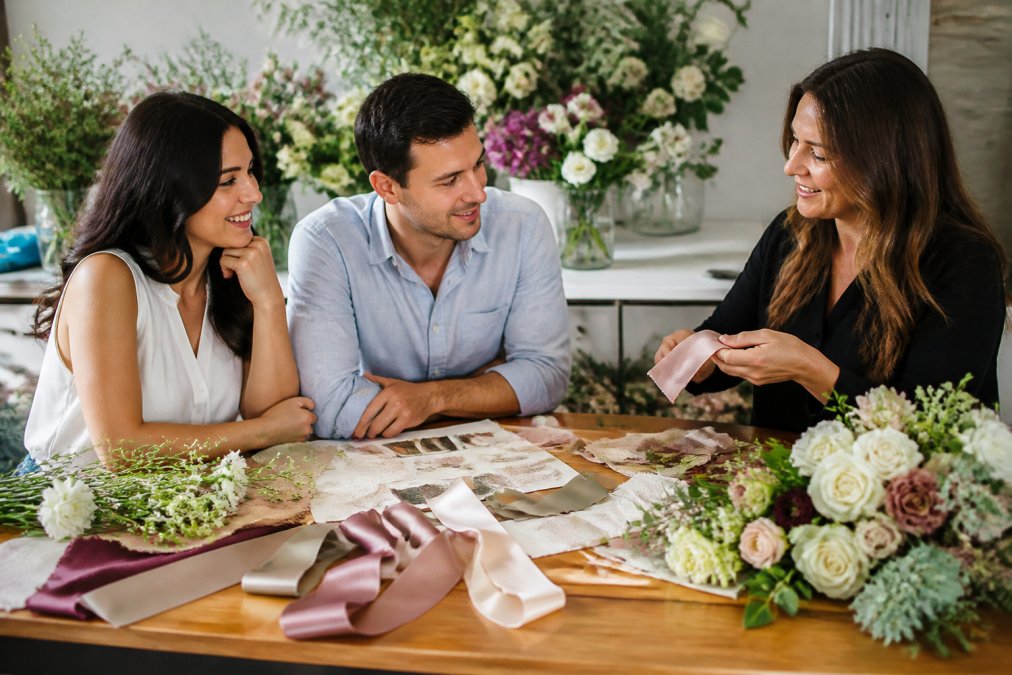
Bring these questions to your meeting:
- What is your flower sourcing process, and can you work with local growers?
- How do you handle a substitution policy when a specific variety is out of season?
- What is included in the floral proposal, and what costs extra?
- How many weddings do you take on the same weekend?
- Who sets up and who breaks down the installation?
- What are your delivery logistics and setup windows at my venue?
Reviewing Portfolios and Understanding Seasonal Flower Availability
A portfolio shows style; it doesn't always show range. Look for at least three weddings at venues similar to yours in scale and lighting, and ask to see one event photographed from setup through the reception.
Contract Terms, Red Flags, and Legal Protections
A floral contract is a working document, not a formality, and it is the piece of paperwork most couples skim. What most guides never explain is which clauses decide what happens when something goes wrong, and in floral design, something usually does, because you are contracting for a perishable product that depends on a global supply chain, a harvest window, and a venue's load-in rules.
The payment and deposit structure
Most floral designers require a retainer to hold your date, typically a percentage of the estimated total, with the balance due in one or two installments before the event. What matters is what the retainer buys. A retainer that reserves your date and applies to your final balance is standard. A "non-refundable" retainer with no stated purpose is a yellow flag, ask in writing what it covers (date hold, design labor, wholesale orders already placed).
The substitution clause
This is the most important clause in the document and the one most couples never read closely. Because flowers are agricultural, no designer can guarantee a specific variety will be available on your date. A strong substitution clause:
- It names the specific varieties in your design, not just "seasonal blooms."
- It states the substitution standard, usually "equal or greater value and a comparable color, texture, and scale."
- It requires notification before the swap, or at minimum a same-day explanation.
Cancellation, postponement, and force majeure
Cancellation terms are usually tiered by how close you are to the event, because the designer's costs are incurred on a timeline: design labor early, wholesale orders in the final weeks, perishable product in the final days. A common structure refunds more the earlier you cancel and retains more as the date approaches. Ask for the tiers in writing and ask how postponement is treated, many contracts treat it as a cancellation unless you negotiate otherwise.
Setup, breakdown, and venue rules
Your venue may restrict load-in windows, prohibit open flame, require vendor insurance, or charge for after-hours breakdown. If the contract doesn't say who handles those requirements, you may absorb the cost or the conflict on the day. Ask the designer to confirm in the contract: arrival window, setup completion time, who removes installations, and whether a breakdown fee applies.
Red flags to watch for
- No written substitution policy, or one that gives the designer unlimited discretion
- A non-refundable retainer with no stated purpose
- Vague language about setup, breakdown, or venue restrictions
- No named on-site contact for the day of the event
- A total that can change without your written approval
- Pressure to sign before you have seen a detailed floral proposal
- No cancellation or postponement tiers at all
Ask for the contract to name the specific flower varieties in your design, not just "seasonal blooms." That single line protects you if a bloom gets swapped for something cheaper.
Sustainable Practices and Floral Repurposing Strategies
Eco-friendly floral practices are no longer niche, and they are one of the few areas where a couple can cut cost and waste at the same time. The practical version starts with the mechanics.
Foam-free mechanics, explained
Traditional floral foam, the green block designers press stems into, is a single-use plastic foam that does not biodegrade and is hard to recycle. Foam-free design replaces it with chicken wire, reusable pin holders (kenzan), water tubes, moss, or hand-tied and wired techniques. The trade-off is real: foam-free installations take more labor and more frequent water checks, so some designers charge a modest premium.
Sourcing: local, seasonal, and certified
Locally grown, in-season stems travel shorter distances and are cut closer to peak, so they often last longer in the vase and carry a lower shipping footprint. The catch is availability: a locally sourced palette in a cold month is narrower than a wholesale palette flown in. A designer who sources locally steers you toward what is at its peak, usually the most cost-effective option.
Repurposing: the actionable playbook
Repurposing is where sustainability and budget meet. The principle is simple: every arrangement that serves two moments in the day is one you did not pay for twice. The execution requires planning before the flowers are built, not on the day.
Here is how to plan it:
- Ceremony arch or chuppah to reception backdrop. Ask the designer to build the ceremony installation on a movable frame or in sections that can be lifted and re-anchored behind the head table or the band. This is the single highest-ROI repurposing move because ceremony installations are usually the largest line item.
- Aisle arrangements to cocktail-hour or bar decor. Aisle pieces in vessels can be carried to the bar, the escort-card table, or the cocktail tables with no rebuild.
- Bridesmaid bouquets to centerpieces. A bouquet rewrapped into a low vessel becomes a centerpiece in minutes. Ask the designer to build the bouquets at a scale that works as a centerpiece so the proportions hold.
- Ceremony aisle petals to reception scatter. If petals are used on the aisle, ask whether they can be swept and reused at the reception entrance rather than discarded.
- Altar or entry urns to buffet or gift-table decor. Large urns travel well if they are built in a stable vessel and the venue allows moving them.
What to ask before you book
Ask your wedding floral designer to walk through the full day and flag every piece that could serve a second purpose. Ask who moves the pieces, when, and whether the venue allows it. Ask whether the quote accounts for repurposing or prices it separately. A designer who plans repurposing from the start builds arrangements to travel; one who doesn't builds them to stay put, and that difference is decided at the design table, not on the wedding day.
Delivery Logistics and How to Preserve Your Wedding Bouquet
Delivery logistics decide whether your flowers arrive fresh or stressed, so confirm the setup window with your venue and florist in the same conversation. Ask who is on site, how early they arrive, and who handles the flowers after the event.
Frequently Asked Questions
How much of my wedding budget should go toward flowers?
A common guideline is 8 to 10 percent of your total wedding budget for floral design. If you are planning a large ceremony installation or a heavy tablescape design, that figure can climb to 15 percent. Start with your overall budget, subtract fixed costs like venue and catering, and then decide what feels comfortable for flowers. A wedding floral designer can help you allocate that number across bouquets, centerpieces, and ceremony pieces.
How far in advance should I book my wedding floral designer?
For peak wedding season, book your wedding floral designer six to nine months before your date. Popular designers often fill their calendar a year out. If your wedding falls during a busy month or you need a large ceremony installation, start conversations even earlier. Booking early also gives you time to review the floral proposal, adjust the color palette, and confirm seasonal blooms that fit your vision.
What is the difference between a floral designer and a traditional florist?
A traditional florist focuses on everyday arrangements, holiday orders, and gift deliveries. A wedding floral designer specializes in event design, from bridal bouquets and boutonnieres to large ceremony installations and reception tablescapes. They often handle logistics, setup, and breakdown on the wedding day. For a wedding, you want someone who understands floral mechanics, venue restrictions, and how to keep centerpieces fresh through a long reception.
How do I communicate my floral vision to my designer?
Bring an inspiration board with photos of bouquets, centerpieces, and ceremony installations you love. Note the flower varieties, color palette, and overall floral aesthetic in each image. Share your wedding theme, venue, and any restrictions. Be clear about what you dislike, too. A good designer will ask about your budget, seasonal availability, and how you want the space to feel, then translate that into a floral proposal.
What are common mistakes when choosing wedding flowers?
Common mistakes include skipping the budget conversation, choosing a designer without reviewing a full portfolio, ignoring seasonal flower availability, and failing to ask about a substitution policy. Many couples also forget to discuss delivery logistics, setup times, and venue restrictions. Another frequent error is not asking who will handle floral maintenance and breakdown. A detailed contract and a clear timeline prevent most of these problems.
Can I preserve my wedding bouquet after the wedding?
Yes. You can preserve your wedding bouquet by air-drying, pressing, or having it professionally freeze-dried or resin-cast. Start within a day or two of the wedding, before the flowers wilt. Keep the bouquet in a cool, dark place and avoid direct sunlight. If you want a keepsake, ask your wedding floral designer which flower varieties in your bouquet hold up best to preservation, since some blooms dry more successfully than others.