 how-to
Avoiding Hidden Fees at Online Flower Shops
Table of Contents
- How Hidden Fees Inflate Your Final Total at Checkout
- Flower Delivery Service Fees Explained
- Local Florist vs National Wire Services: Where Your Money Actually Goes
- How to Spot Fake Online Florists Before You Pay
- Your Rights as a Flower Delivery Customer
- What Transparent Flower Shopping Looks Like at Yole Flower Boutique
- Conclusion
- Frequently Asked Questions
Last Updated: September 13, 2026
How Hidden Fees Inflate Your Final Total at Checkout
The bouquet you clicked on was never the price you were going to pay. That gap between the advertised base price and the final total, the hidden fees flowers shoppers complain about most, is the most common complaint in online flower shopping, and it is almost always deliberate.
Hidden fees flowers are charges added after you have committed to a purchase: service fees, handling charges, delivery surcharges, and fuel add-ons that appear only once your card is on the screen. Avoiding them comes down to one skill: reading the checkout page before you fall in love with the arrangement.
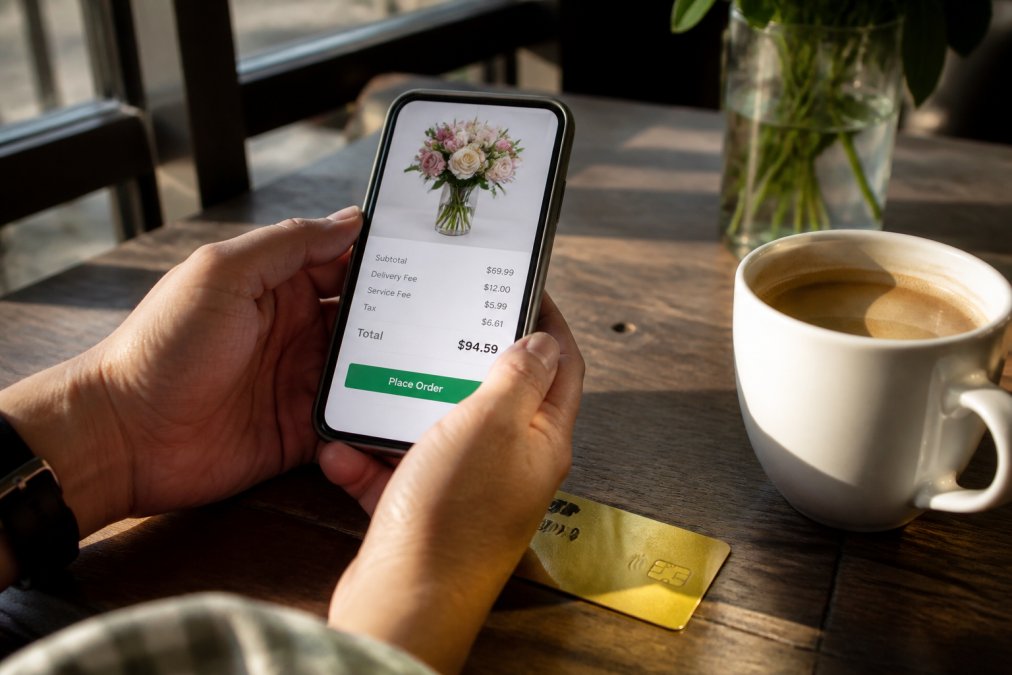
The Fee Stack: Service, Handling, Delivery, and Fuel
Most inflated totals are built from the same four layers. A service fee covers the platform's overhead, often as a percentage of your order. A handling charge pays for assembly and packaging. Delivery surcharges apply to specific dates, zip codes, or same-day requests. A fuel surcharge appears when the platform routes your order through a courier network rather than its own drivers.
Each fee looks small alone. Stacked, they push the total well above the base price you clicked on, and none buys you a single extra stem.
Flower Delivery Service Fees Explained
A flower delivery service fee covers getting your arrangement from the design bench to the recipient's door. That is legitimate. What is not is a fee that appears only after you enter payment details, or one labeled vaguely enough that you cannot tell what you are paying for.
An honest delivery fee is stated up front, tied to a specific window and address, and does not change at payment. The dishonest version is a moving target: order-gatherer sites show a low base price, then reveal the real cost in the final two screens, when abandoning the cart feels like more effort than paying.
Watch for these patterns:
- A "service fee" calculated as a percentage of your order rather than a flat amount
- A "handling charge" that appears only on certain dates
- A delivery fee that changes after you enter a zip code
- A fuel or "route" surcharge with no explanation of what it covers
If a fee cannot be explained in one sentence, ask why it exists before you pay it.
How the Order-Gatherer Business Model Inflates Every Fee
Most articles say "watch out for order gatherers" without explaining how the model works. Understanding the mechanism is what lets you spot it.
An order gatherer is a website that does not design or deliver flowers. It runs a storefront, buys search ads, and collects orders. At checkout, three things happen:
- The gatherer captures your full payment. You are charged the advertised price plus service, handling, and delivery fees, often 30% to 50% above the base price by the confirmation screen (the FTC).
- The gatherer forwards a reduced order to a real florist. It keeps a commission (often called a fulfillment or wire fee) and remits the rest to a local shop it has never met, chosen by a dispatch system based on geography and availability.
- The local florist builds to the remitted budget, not your budget. If you paid $80 and the gatherer kept $30, the florist designs an arrangement worth roughly $50 in materials and labor. The photo you clicked showed a $80 arrangement.
That gap, between what you paid and what the florist received, is the real hidden fee. It is not a line item on your receipt; it is baked into the design, which is why the same recipe can arrive thinner, shorter, or filled with cheaper stems than promised.
Why the Fee Stack Is Not the Same as a Markup
A local florist's delivery fee covers a driver, fuel, and time. A gatherer's fee stack covers advertising, a call center, a website, and profit, none of which touches your arrangement. When you see four separate fees, ask which pays for a human to design or deliver your flowers. If the answer is "none," you are funding a middleman, not a florist.
Local Florist vs National Wire Services: Where Your Money Actually Goes
Comparing a local florist to a national wire service is not just about price, it is where your money lands. A local florist designs in-house, controls every stem, and can tell you who is delivering. A wire service or order gatherer takes your order, skims a fee, and forwards what remains to a shop you never chose.
The consequences show up in substitution, timing, and accountability. Wire services often fill orders with whatever is available that day, which is why the substitution policy matters more than the listing photo. Timing is controlled by a dispatch system, not a designer. And when something goes wrong, you negotiate with a call center rather than the person who built the bouquet.
Wire Service vs. Order Gatherer: They Are Not the Same Thing
Most guides lump these together. They are different businesses with different fee structures, and knowing which one you are on changes what to watch for.
A wire service is a membership network of real florists. A local shop pays dues and a per-order fee to send or receive orders through it. When you order through a wire service's consumer site, a real florist in the recipient's area fills the order, but the network takes a cut before the florist is paid. The florist is real; the markup is the network's.
An order gatherer is not a network of florists at all, it is a marketing operation, with no designers, no delivery vehicles, and no florist relationships beyond a dispatch list. It exists to intercept search traffic and resell orders at a markup. That markup is larger and less transparent than a wire service's, leaving the filling florist even less of your original budget.
Both models reduce what reaches the arrangement. The gatherer reduces it more, and hides it better.
Tracing the Dollar: A Concrete Example
Say you pay $75 for a bouquet on a third-party site. Here is roughly how that $75 splits under each model. These are illustrative splits based on commonly reported industry patterns, not quotes from any specific company:
| Model | Platform Keeps | Florist Receives | What Gets Designed |
|---|---|---|---|
| Direct local order | $0 (you pay the florist) | ~$75 minus delivery | Full $75 arrangement |
| Wire service | Network fee + per-order charge | Reduced amount | Smaller arrangement |
| Order gatherer | Service, handling, and delivery fees | Substantially reduced amount | Smallest arrangement |
Exact percentages vary by company and order size, but the direction is always the same: every layer between you and the florist takes a slice out of the stems. That is why the same $75 buys a fuller arrangement ordered direct.
What This Means for Substitution and Timing
A local florist substitutes because a stem is out of season or unavailable that morning, and can call to ask first. A wire service or gatherer substitutes because the remitted budget will not cover the listed recipe, often without notifying you. The substitution policy makes the money flow visible: a shop that received your full budget can honor the recipe; one that received a fraction cannot.
Timing works the same way. A local shop controls its own delivery route and can give you a window. A gatherer's dispatch system assigns your order to whichever shop accepts it, which is why same-day requests on third-party sites often arrive late or not at all.
How to Spot Fake Online Florists Before You Pay
A fake or order-gathering florist presents itself as a local shop but has no storefront, no local designers, and no ability to fill your order itself. The tell is in the details: a vague address, a phone number routing to a call center, and stock photography that appears on dozens of other sites.
Before entering payment details, verify three things. The physical address: a real shop lists a street address you can look up. The phone number: call it and see whether a person at the shop answers. The photos: reverse-search one image and see whether it appears across unrelated sites.
Federal Trade Commission guidance on deceptive online advertising is clear that misleading pricing and undisclosed fees can constitute deceptive practices, which is why the burden of transparency sits with the seller, not with you.
The 5-Point Checkout Audit Checklist
Run this audit before you pay on any flower website. It takes about two minutes and is the fastest way to avoid a surprise total.
- Base price vs. final total: Add the item to your cart and compare the product-page price to the checkout total. If the gap is large and unexplained, stop.
- Fee breakdown: Every charge should have a plain-language label. "Service fee," "handling," and "fuel surcharge" with no explanation are red flags.
- Physical address: Confirm a real street address and cross-check it against a map listing.
- Phone test: Call the listed number. A local shop answers locally; a gatherer routes you to a call center.
- Substitution policy: Read what happens if a specific flower is unavailable. A vague policy means you may not get what you ordered.
| Warning Sign | What It Usually Means | What To Do |
|---|---|---|
| Price jumps at checkout | Percentage-based service fee added late | Abandon and order direct |
| No street address listed | Order gatherer with no local shop | Verify before paying |
| Call center answers | Order is brokered, not designed | Ask who fills the order |
| Vague substitution policy | Substitutions made without notice | Request a written policy |
| Stock photos on many sites | Listing is not a real local shop | Reverse-search the image |
Your Rights as a Flower Delivery Customer
You have more protection than most flower shoppers realize. U.S. consumer protection law requires sellers to disclose material terms, including fees, before you complete a purchase. If a charge appears only after you have committed, that is a disclosure problem, not a you problem.
Your practical rights come down to three things: to know the full price before paying, to a product matching its description, and to a remedy when it does not. If an arrangement arrives materially different from what you ordered, or the total charged differs from the total shown, dispute the charge with your card issuer. Keep your order confirmation and a photo of what arrived; both make a dispute straightforward.
Consumer Financial Protection Bureau guidance on disputing credit card charges explains the dispute process and the timelines that apply.
What Transparent Flower Shopping Looks Like at Yole Flower Boutique
Transparent flower shopping means the price you see is the price you pay, and the person who designs your arrangement is accountable for it. That is the standard at Yole Flower Boutique.
As a local shop, we handle our own designs and deliveries, so no platform skims a fee between you and the florist. Custom work, including wedding consultations, is quoted up front. For sympathy orders, our team walks you through appropriate options and timing rather than leaving you to guess. Current pricing depends on the arrangement, delivery date, and address, so check our site or call for a quote.
Conclusion
The flower industry's fee problem is not really about fees. It is about who controls the information between the photo and the payment screen, and too many platforms profit by keeping that gap wide. You can close it with a two-minute checkout audit and a phone call.
If you would rather skip the audit, Yole Flower Boutique designs and delivers locally, quotes custom work up front, and handles sympathy and celebration orders. Order direct and get an arrangement built by the people who actually deliver it.
Frequently Asked Questions
Why do online flower prices jump at checkout?
Many flower delivery websites advertise a low base price but add service fees, handling charges, delivery surcharges, and fuel fees at checkout. These hidden fees flowers sites apply can inflate the final total by 20% or more. The advertised price often reflects only the floral arrangement itself, not the cost of getting it to your recipient. Before you pay, review the full order breakdown line by line.
What is the difference between a service fee and a delivery fee?
A delivery fee covers the cost of transporting your arrangement to the recipient's address. A service fee is a separate charge that some online platforms add for processing your order. On third-party sites, the service fee often goes to the platform, not the florist. A local florist may charge a single delivery fee with no separate service fee, so your money goes toward the arrangement itself.
How can I tell if an online florist is a real local shop?
Check for a verified physical address and a local phone number you can call. Look for photos of the actual storefront and real customer reviews that mention specific local experiences. A legitimate local florist will list their shop address and let you visit in person. If the website only shows a contact form, a toll-free number, and stock photos, it may be an order gatherer rather than a real flower shop.
Are service fees for flower delivery mandatory?
No. Service fees are not required by law and vary by company. Some online platforms charge them to cover processing and customer support, while many local florists do not charge a separate service fee at all. When comparing prices, ask whether the quoted price includes delivery and any handling charges. A florist who gives you the final total upfront is being transparent.
Ready to order flowers without the checkout surprises? Yole Flower Boutique offers local design, up-front pricing, and daily delivery for milestones, sympathy tributes, and everything in between. Get started with Yole Flower Boutique and send something that looks like what you ordered.