 how-to
How to Choose Appropriate Sympathy Flowers: A Guide
Table of Contents
- Understanding the Meaning of Sympathy Flowers
- Funeral Flower Etiquette: What to Send and When
- Choosing Flowers Based on Your Relationship to the Deceased
- Types of Sympathy Flowers and Funeral Arrangements
- What to Include in a Sympathy Card Message
- Eco-Friendly and Sustainable Funeral Floral Options
- Logistics: Delivery and Post-Funeral Flower Care
- Frequently Asked Questions
Last Updated: September 16, 2026
Understanding the Meaning of Sympathy Flowers
Sympathy flowers are floral tributes sent to express condolences, comfort, and respect during a time of loss. At Yole Flower Boutique, we've guided countless families through this decision, and the gesture matters more than perfect details.
Traditional Blooms and Their Symbolism
Certain flowers carry centuries of mourning associations.
- Lilies signal purity and the soul's return to peace, making them a standard choice for memorial services.
- Roses in white or pale tones express reverence and humility; red roses are usually reserved for a spouse or partner.
- Carnations represent a mother's enduring love and appear often in tribute flowers for parents.
- Chrysanthemums symbolize grief and support in many cultural traditions.
- Hydrangeas convey heartfelt gratitude and are common in bereavement arrangements.
A common mistake is choosing for color while ignoring traditional meaning. Most florists will steer you right if you explain your relationship to the deceased.
Color Symbolism in Funeral Arrangements
Color does as much emotional work as flower type. White signals purity, peace, and reverence and works in nearly every setting; soft pastels suggest warmth and gentle remembrance; bright colors suit a celebration-of-life service; deep reds and burgundies communicate love and sorrow, so use them when the relationship was especially close.
Funeral Flower Etiquette: What to Send and When
Funeral flower etiquette is less rigid than most people fear. The core rules: send promptly, address the arrangement correctly, and avoid creating work for the grieving family. For a service, aim for arrival the morning of the viewing or service; for a residence, delivery within the first week is customary.
Sending to the Funeral Home vs. the Family's Residence
Where you send an arrangement changes how it is addressed and what type works best.
| Destination | Best Arrangement | Timing | Addressed To |
|---|---|---|---|
| Funeral home | Standing spray, wreath, casket spray | Morning of service | Deceased's name, in care of funeral home |
| Family's residence | Vase arrangement, sympathy plant | Within first week | Family's surname |
| Church or memorial venue | Standing arrangement, altar flowers | Before service | Deceased's name |
Flowers vs. Sympathy Plants: Which Is More Appropriate?
Sympathy flowers suit the service itself, creating a visible tribute shared among attendees. Sympathy plants, including peace lilies, orchids, and blooming houseplants, last far longer and give the family something living to care for. Neither is more correct: flowers make a stronger statement at the service, while plants offer lasting remembrance.
Choosing Flowers Based on Your Relationship to the Deceased
Your relationship to the deceased should drive the arrangement's scale, the tribute's tone, and whether you order independently or contribute to something the family is coordinating.
- Spouse or partner: The immediate family usually selects the casket spray, and a spouse or partner often leads that decision. If you are a partner sending independently, a large standing spray in red or white roses is appropriate.
- Parent, sibling, or child: A standing spray in soft tones (lilies, chrysanthemums, roses) is common. Siblings sometimes coordinate on one large spray rather than several smaller ones, keeping the service from being overwhelmed with duplicate tributes.
- Close friend: A vase arrangement in the deceased's favorite colors, or a standing spray if you were part of the inner circle. This is the tier where personalization matters most.
- Colleague or business associate: A modest bouquet or sympathy plant for the family's home. From a workplace, one arrangement from the whole office is usually more appropriate than a dozen individual orders.
- Distant acquaintance: A sympathy card, or a small arrangement if you plan to attend the service. There is no obligation to send flowers to someone you barely knew.
Coordinating With the Family Before You Order
The single most useful step is checking whether the family has made any requests. Funeral homes and clergy are often the fastest source. Common patterns include:
- The family asks for donations to a charity in lieu of flowers. Honor this. Sending flowers anyway is not a neutral gesture; it can read as ignoring a direct request.
- The family requests plants only, usually because they expect a high volume of arrangements and want something that lasts past the service.
- The family designates a specific color palette (often all-white, or the deceased's favorite color) so the service looks cohesive.
- The family asks that tributes be sent to the funeral home rather than the residence, or vice versa.
Group Gifts and Splitting Costs
When several people contribute, one larger arrangement usually reads better than several small ones. A common approach: one person places the order, collects contributions, and lists the group on the card (for example, "From the [Department/Team/Family]"). Keep attribution simple; long name lists crowd the enclosure card.
A Note on Pet Loss
Pet sympathy flowers follow the same etiquette as human loss but on a smaller scale. A modest bouquet or sympathy plant sent to the owner's home acknowledges a loss often overlooked by others. With no funeral home to coordinate with, timing is simply "within the first week or two."
Types of Sympathy Flowers and Funeral Arrangements
Sympathy arrangements fall into distinct categories, each serving a different purpose at a service or in the home. The type you choose depends on where it will be displayed, how prominent you want the tribute, and who is coordinating the service.
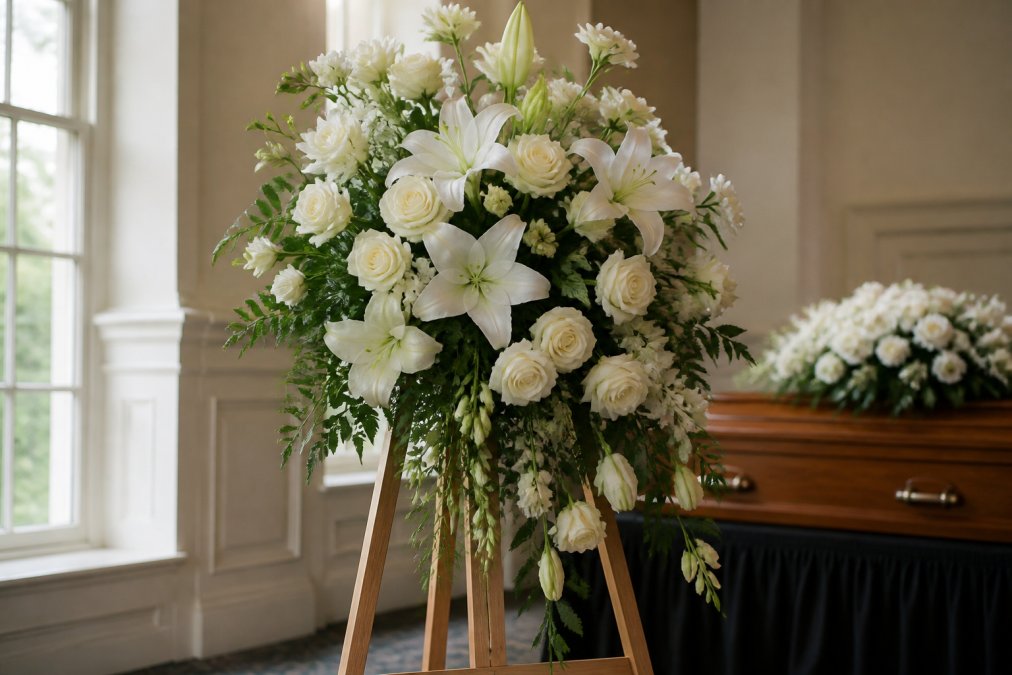
Casket Sprays, Standing Sprays, and Wreaths
A casket spray is the large arrangement placed on top of the closed or open casket. It is almost always ordered by the immediate family, because it sits at the center of the service and sets the visual tone. Casket sprays are the largest and most expensive category, typically ordered through the funeral home's preferred florist or one the family trusts.
Bouquets and Vase Arrangements for the Home
Vase arrangements and bouquets are the practical choice for the family's residence. They arrive ready to display, require no setup, and move between rooms as the family receives visitors. Freshness matters most here, because a home arrangement that wilts in two days adds stress rather than comfort.
Sympathy Plants and Living Tributes
Sympathy plants, including peace lilies, orchids, and blooming houseplants, last far longer than cut flowers and give the family something living to care for. They are a strong choice when the family requests plants only, when the service is small or private, or when you want the gesture to extend past the funeral.
How Arrangement Type Affects Cost and Delivery
Cost is driven mainly by size, stem count, and premium blooms (lilies, roses, orchids). A standing spray uses more stems and mechanics than a table arrangement, so it costs more. Casket sprays are the largest and typically most expensive; vase arrangements and plants sit at the lower end.
A Note on Sustainable Options
If sustainability matters to the family, ask your florist for arrangements built with reusable mechanics such as chicken wire or moss instead of floral foam, which is not biodegradable. Seasonal, locally grown blooms travel shorter distances and often produce a fresher arrangement than imported flowers shipped in cold storage. Many families now request that arrangements be donated to nursing homes, churches, or hospitals after the service rather than discarded.
What to Include in a Sympathy Card Message
A simple structure that works:
Dear [Family Name], I was so sorry to hear about [Name]. [He/She/They] always [specific memory or quality]. Please know I am thinking of you, and I am here if you need anything. With deepest sympathy, [Your Name]
Eco-Friendly and Sustainable Funeral Floral Options
Sustainable funeral floral options are growing in demand as families seek tributes that align with the deceased's values. The main considerations are sourcing, foam use, and what happens to the arrangement after the service. Many conventional arrangements rely on non-biodegradable floral foam; ask your florist for reusable mechanics such as chicken wire or moss instead.
Logistics: Delivery and Post-Funeral Flower Care
Delivery logistics are where sympathy orders most often go wrong. Funeral homes receive multiple deliveries on service days, and arrangements must be labeled clearly with the deceased's name and the sender. Confirm the delivery window with the funeral home before ordering, and give your florist the exact service time. For a private residence, coordinate with the family or a designated contact so flowers are not left on a porch in the heat.
- Trim stems at an angle and change the water every two days.
- Keep arrangements out of direct sun and away from heating vents.
- Remove wilting blooms promptly to keep the rest fresh.
- For sympathy plants, water according to the care tag and repot only after the grieving period.
- Consider donating arrangements to a hospital or care facility once the service concludes.
Frequently Asked Questions
What are the most appropriate sympathy flowers?
The most appropriate sympathy flowers are those that convey respect and comfort, such as lilies, roses, orchids, and chrysanthemums. Lilies symbolize the soul's return to innocence, while white roses represent reverence. Chrysanthemums are often used in memorial services. When choosing sympathy flowers, consider the family's preferences and any religious or cultural traditions. Seasonal blooms can also be a thoughtful choice. Yole Flower Boutique offers a selection of sympathy arrangements designed with these meanings in mind.
What is the proper funeral flower etiquette?
Funeral flower etiquette involves sending flowers to the funeral home or the family's residence before the service. If sending to the funeral home, coordinate with the director for delivery timing. For visitations, flowers can be sent to the home. It's respectful to include a sympathy card with a personal message. Avoid sending flowers if the family requests donations instead. Also, be mindful of religious customs; for example, some traditions prefer plants over cut flowers. Yole Flower Boutique can guide you through these considerations.
What flowers should I avoid in sympathy arrangements?
Avoid flowers with strong fragrances, such as stargazer lilies, as they can be overwhelming in a closed setting. Also, avoid bright, festive colors like neon pink or orange unless the family specifically requests them. Red roses are typically reserved for romantic occasions, so they may not be appropriate. Some cultures avoid white flowers for funerals, so it's best to check with the family or a florist. Yole Flower Boutique can help you select respectful blooms.
Should I send flowers to the funeral home or the family's residence?
Both options are appropriate, but timing matters. Sending flowers to the funeral home is common for the service itself, ensuring they arrive before the viewing or ceremony. If you send to the family's residence, it provides comfort after the service. For delivery to a funeral home, provide the deceased's name and service time. For home delivery, ensure someone is there to receive them. Yole Flower Boutique offers reliable delivery to local funeral homes and residences, so you can focus on supporting the family.