 how-to
How to Keep Prom Corsages Fresh Longer: 2026 Guide
Table of Contents
- Step 1: Pick Up Your Corsage at the Right Time
- Step 2: How to Store a Corsage in the Fridge Properly
- Step 3: Handle Wearable Flowers With Care
- Step 4: How Long Do Prom Corsages Last?
- Step 5: How to Preserve a Corsage After Prom
- Common Mistakes That Shorten Corsage Freshness
- Frequently Asked Questions
Last Updated: September 15, 2026
Step 1: Pick Up Your Corsage at the Right Time
The single biggest factor in how to keep prom corsages fresh longer is timing: pick up your corsage as close to the event as possible, ideally the same day. Every hour a cut flower spends out of water is an hour subtracted from its vase life, and a corsage is a cut flower with no water source at all.
We recommend picking up prom corsages as close to the event as possible, ideally the same day. A corsage assembled at 9 a.m. and worn at 7 p.m. has already lost a full day of freshness before the first photo.
If same-day pickup isn't possible, ask for the latest pickup slot available. Colorado State University Extension's guide to cut flower care explains that stems seal themselves as they dry, which is why a corsage that sits in a box overnight often wilts faster than one worn immediately.
Step 2: How to Store a Corsage in the Fridge Properly
Learning how to store a corsage in the fridge is the difference between a bloom that lasts through the last dance and one that's brown by dinner. The refrigerator slows the flower's natural aging process, but only if you store it correctly.
Follow these steps:
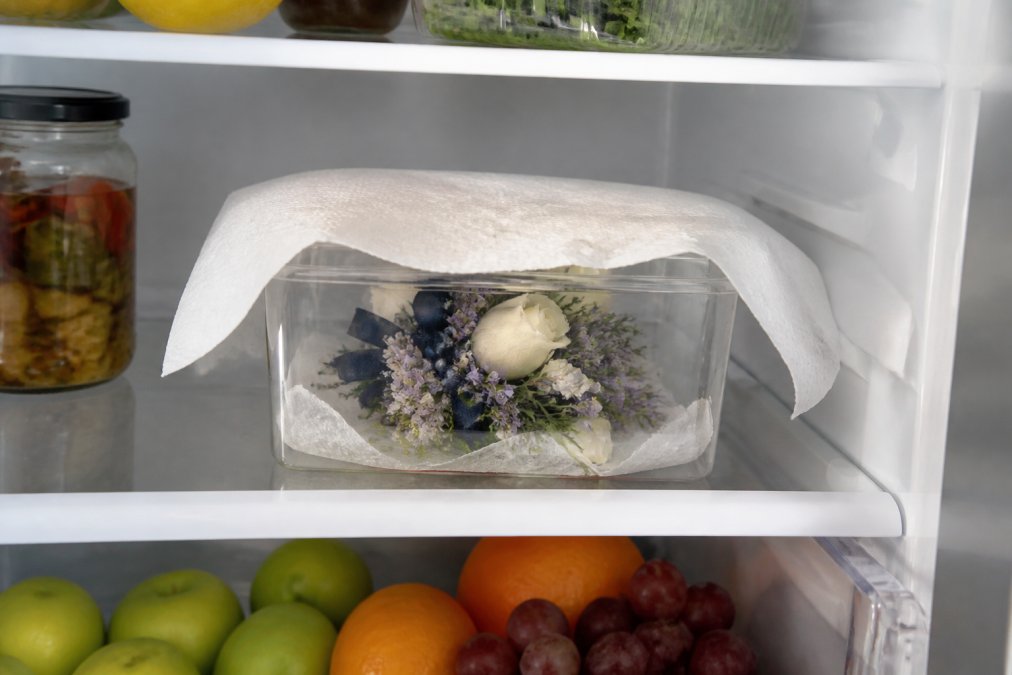
- Leave the corsage in its original box or clamshell container
- Lay a slightly damp paper towel (not soaking wet) over the blooms
- Place the box on a middle shelf, away from the walls and the back
- Keep it there for no more than 8-12 hours before the event
- Pull it out about 30 minutes before you leave so it warms gradually
Temperature and Humidity Settings That Protect Blooms
The ideal refrigeration temperature for cut flowers sits in the cool, steady range your fridge already maintains for produce. More important than the exact number is consistency. Temperature fluctuations cause condensation inside the box, and condensation leads to mold on petals and ribbon.
Keep the humidity moderate. A damp paper towel provides local humidity around the blooms without soaking them. A wet corsage wilts as fast as a dry one, just for a different reason.
Why Ethylene Gas From Fruit Will Ruin Your Corsage
Ethylene gas is a natural plant hormone that ripens fruit and, unfortunately, ages flowers (Ethylene Role in Plant Growth, Development and Senescence). Produce like bananas, apples, and avocados release it continuously, and a corsage stored near them will wilt and drop petals far sooner than one stored alone.
This is the storage mistake we see most often, and it's completely invisible to most people. Your crisper drawer full of apples is the worst possible neighbor for a prom corsage.
Step 3: Handle Wearable Flowers With Care
Wearable flowers bruise easily, and petal bruising is permanent. Once a petal is crushed, no amount of refrigeration brings it back. But handling isn't just about avoiding damage, it's also about knowing what to do when something goes wrong in the ten minutes before you walk out the door.
Basic Handling Rules
Handle the corsage by the stem or the ribbon-wrapped base, never by the blooms. When pinning it on, have the wearer stand still and pin through the backing, not the flowers. Floral tape and floral wire hold the arrangement together, but they don't protect petals from fingers. A common mistake is spraying the corsage with water right before wearing it. A light mist is fine hours earlier; a heavy mist at the last minute leaves water spots and encourages mold. If you mist, do it before storage, not after.
Emergency Repair: What to Do When Something Breaks
Most corsage disasters happen in the final hour, and most of them are fixable. Keep a small repair kit on hand before prom night: floral tape, a couple of extra floral pins, clear craft glue, small scissors, and a few spare blooms if your florist will provide them.
If a petal falls off: Don't try to reattach a single petal with glue, it will look worse than the gap. Instead, tuck the bloom deeper into the arrangement so the missing petal faces inward, or swap in a spare bloom of the same type. If the petal is a large outer guard petal on a rose, you can often peel the remaining guard petals back slightly to create a smaller, cleaner bloom.
If the stem snaps: Wrap floral tape tightly around the break point, overlapping the tape onto both sides of the break by at least half an inch. Floral tape is stretchy and adheres to itself, so a snug wrap will hold a snapped stem through an evening as long as the bloom isn't heavy. For a fully severed stem, a short length of 22- or 24-gauge floral wire threaded alongside the stem and taped in place will splint it.
If the ribbon or wristband comes loose: Re-pin the corsage to the backing rather than the wearer's clothing. Pinning through fabric risks tearing a dress or tux, and the corsage will sit more securely on its own backing anyway.
If the whole corsage wilts before the event: This usually means it sat too long out of the fridge or next to produce. There's no full recovery, but a 20-minute rest in a cool, dark spot with a damp paper towel over the blooms will perk up carnations and orchids noticeably. Roses rarely bounce back once they've gone limp.
A Note on Pre-Event Triage
If you're assembling the corsage yourself or picking it up hours early, do a quick inspection before storage: check that the ribbon is secure, the pins are in place, and no petals are already browning.
Step 4: How Long Do Prom Corsages Last?
Here's how the most common corsage blooms actually behave:
| Bloom | Typical Fresh Window | Hydration Need | Notes |
|---|---|---|---|
| Roses | 24-48 hours | Moderate; drink through stem | Petals bruise easily; guard the outer ring |
| Carnations | 2-3 days | Low; very drought-tolerant | The hardiest common corsage flower |
| Orchids (Phalaenopsis) | 2-4 days | Low; hate being wet | Water on petals causes brown spots |
| Alstroemeria | 24-36 hours | Moderate | Drops petals late; handle gently |
| Baby's breath | 2-3 days | Low | Dries in place, useful for keepsakes |
| Lilies of the valley | 8-12 hours | High; very delicate | Often a single-evening flower |
| Stephanotis | 12-24 hours | Moderate | Fragrant but quick to yellow |
Why Flower Type Changes the Math
Planning Your Photos Around Bloom Life
| Factor | Shortens Freshness | Extends Freshness |
|---|---|---|
| Temperature | Heat, direct sunlight | Cool, steady refrigeration |
| Handling | Touching blooms, crushing | Holding by stem or base |
| Storage neighbors | Fruit and produce | Stored alone in a sealed box |
| Moisture | Soaking wet or bone dry | Damp paper towel nearby |
| Flower type | Thin petals, high water loss | Thick, waxy petals |
Step 5: How to Preserve a Corsage After Prom
Air-Drying and Silica Gel Methods
Common Mistakes That Shorten Corsage Freshness
Frequently Asked Questions
How long will a corsage stay fresh?
A typical prom corsage stays fresh for 12 to 24 hours once removed from refrigeration, depending on the flower type. Stored properly in a cool, humid environment, some blooms can hold their shape for up to two days. After prom night, the flowers will begin to wilt naturally. For best results, keep the corsage refrigerated until the last possible moment before the event and avoid direct sunlight or heat during wear.
Should I put my corsage in the refrigerator?
Yes, refrigeration slows wilting and keeps blooms hydrated. Set your fridge between 34 and 38 degrees Fahrenheit and store the corsage in its box or an airtight container. Keep it away from the freezer compartment and any fruit, which releases ethylene gas that speeds up aging. A damp paper towel placed near the stems adds humidity without soaking the petals. Remove the corsage about 30 minutes before the event so it can adjust to room temperature.
What is the best way to store a corsage before prom?
Keep the corsage in its original box or a breathable container lined with a slightly damp paper towel. Place it on a middle shelf of the refrigerator, not near the back where temperatures drop lowest. Avoid sealing it in a plastic bag, which traps moisture and encourages mold. If you pick up the corsage more than a day before prom, ask your florist whether the flowers are already hydrated or need a quick stem re-cut before storage.
How can I preserve my corsage after prom?
To preserve a corsage after prom, remove the flowers from the wearable base and decide between air-drying or silica gel. Air-drying works for sturdy blooms and takes one to three weeks in a dark, dry space. Silica gel preserves color and shape faster, usually in three to five days. Once dried, place the corsage in an airtight container away from humidity and sunlight. Many people frame dried corsages or press individual blooms into keepsake albums.